Introducing Hodget
Hodget is an AI hedge fund engine: a committee of AI analysts that debates every position, a risk gate that can veto them, and a run log you can read end to end.
Most AI trading tools give you a number and ask you to trust it. Hodget is built on the opposite bet: every decision should come with its reasoning attached. A run in Hodget produces the full paper trail — the signals each analyst saw, the thesis they argued, how the committee weighed the disagreement, and what the risk gate clipped or vetoed before anything became a position.
How a run works
A run is one complete pass of the engine over a universe of tickers. It moves through five stages, and each stage writes its decisions to the run log:
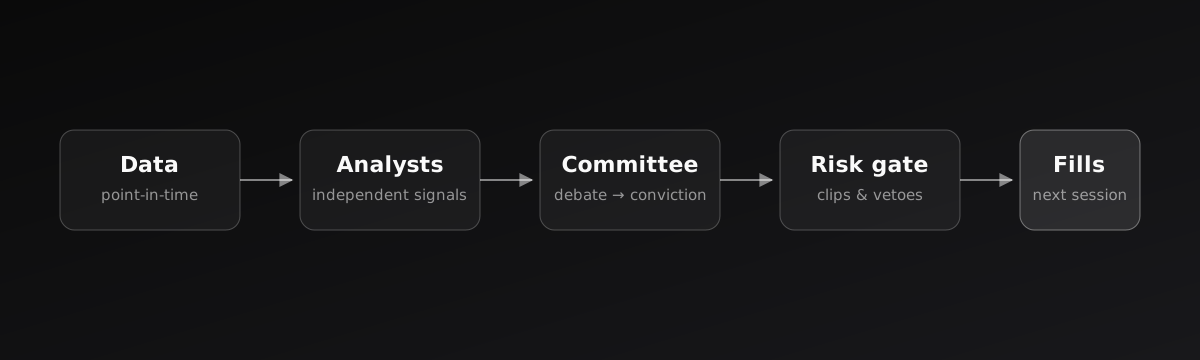
- Data. The engine assembles a point-in-time snapshot: prices, fundamentals, and derived features as they were known on the run date. No lookahead — a backtest run in July sees exactly what a live run would have seen.
- Analysts. A panel of AI analysts evaluates each ticker independently. Each analyst has a distinct style — value, momentum, quality, sentiment — and produces a directional signal with a written thesis.
- Committee. The signals meet. The committee weighs agreement and disagreement into a single conviction score per ticker, and the debate is preserved, not averaged away.
- Risk gate. Position sizing runs through hard constraints: exposure caps, concentration limits, liquidity floors. The gate can clip a position down or veto it outright, and it records why.
- Fills. Surviving targets become orders filled at the next session — the engine never assumes it can trade on the close it just observed.
The run log is the product. Performance charts tell you what happened; the log tells you why — which is the part you need when you decide whether to trust the next run.
What the demo shows
The live demo walks through this with deterministic mock data, so you can explore every surface without an account:
| Surface | What you see |
|---|---|
| Dashboard | Portfolio equity curve, exposure, and recent run activity |
| Runs | Every run with its full decision timeline |
| Strategies | The strategy definitions runs execute against |
| Analysts | The panel: each analyst's style, signals, and hit rate |
| Data | Market coverage, exchange routing, and the point-in-time policy |
Open any run and you get the decisions timeline: signals per analyst, conviction, the committee's reasoning, and every gate clip or veto with its constraint named.
Built to be read
Hodget is TypeScript end to end, and the engine's contracts are plain, inspectable types. A committee decision, for example, is just data:
interface CommitteeDecision {
  ticker: string
  conviction: number // -1 (strong short) … 1 (strong long)
  thesis: string
  dissent: AnalystSignal[] // preserved, never averaged away
}
That is the design principle throughout: no black boxes, no scores without reasoning, nothing you cannot open and inspect.
What's next
The engine runs durably in production today, and the demo tells the full story with mock data. Next up: wiring live runs into the dashboard, expanding market data coverage, and opening up strategy configuration. If you want to follow along, try the demo or sign up.